



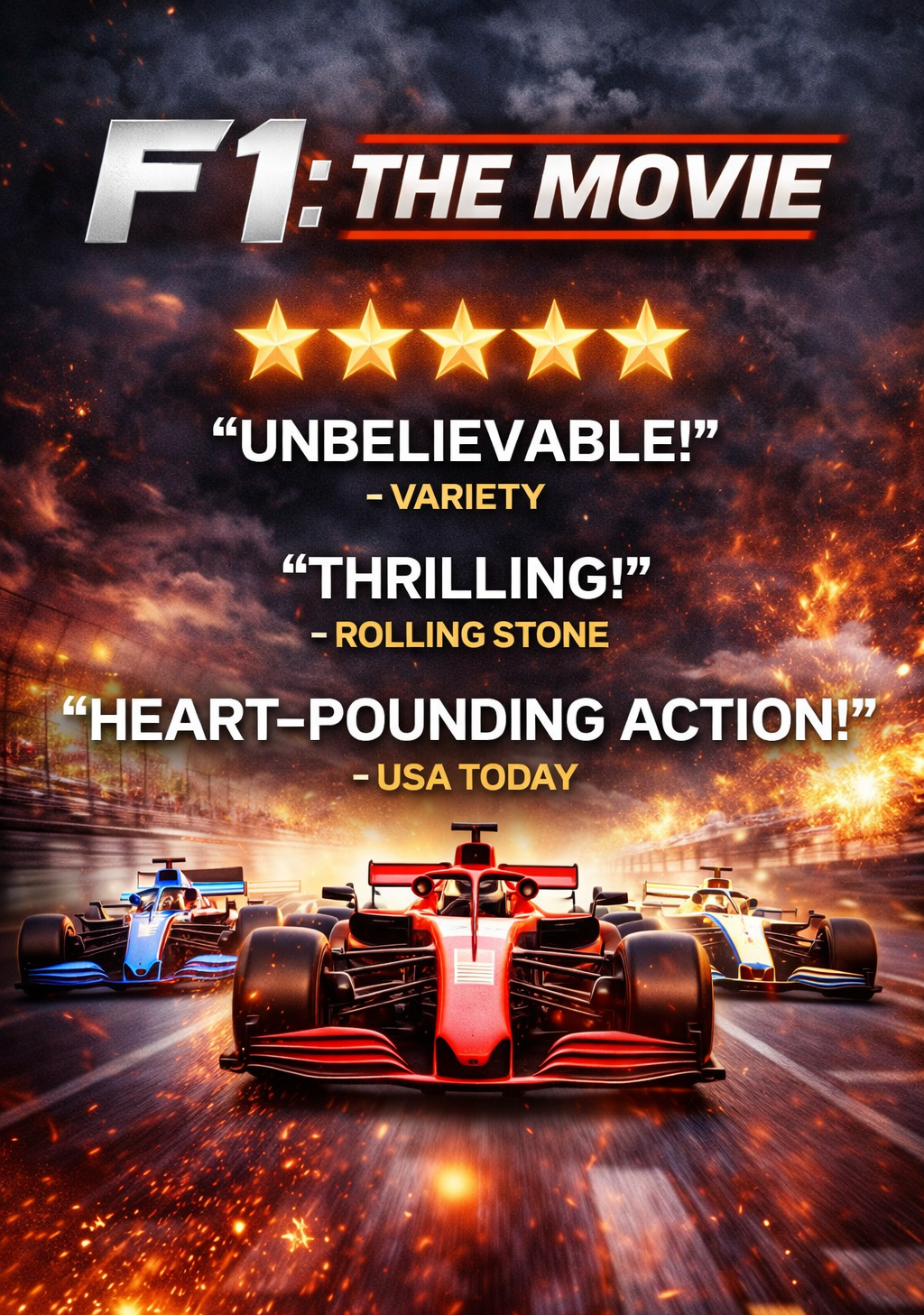
When engines roar and lights go out, the world of Formula 1 transforms into a theatre of thunder. Naturally, when Hollywood decided to capture that adrenaline-fueled universe on the big screen, anticipation surged like a car blasting down the main straight at Monza. F1 The Movie Reviews began trending long before the film hit cinemas, as fans of motorsport and moviegoers alike debated whether the film would do justice to the drama, danger, and dedication that define Formula 1.
Directed by Joseph Kosinski and starring Brad Pitt, this high-budget spectacle promised authenticity, intensity, and emotional depth. Produced with heavy involvement from Formula One and backed by seven-time world champion Lewis Hamilton, expectations were not just high—they were sky-high.
In this comprehensive exploration of F1 The Movie Reviews, we will analyze critical reception, audience reactions, performances, technical execution, storyline, realism, and its impact on both cinema and motorsport culture.
F1 The Movie Reviews: The Premise and Plot Overview
At its core, the film tells the story of a veteran Formula 1 driver making a dramatic return to the sport. Brad Pitt plays a seasoned racer who once dominated circuits but faded into obscurity after a career-altering accident. When a struggling F1 team offers him one last shot at redemption, the narrative shifts into a compelling blend of mentorship, rivalry, and redemption.
The story revolves around:
- A comeback arc filled with emotional stakes
- A rookie teammate eager to prove himself
- Team politics and corporate pressure
- The psychological toll of racing at 300 km/h
F1 The Movie Reviews frequently highlight how the film balances personal storytelling with large-scale racing spectacle. Critics note that while the underdog comeback story may feel familiar, its execution within the Formula 1 framework feels refreshingly intense.
F1 The Movie Reviews: Authenticity and Real Racing Integration
One of the most talked-about aspects in F1 The Movie Reviews is authenticity. Unlike many racing films that rely heavily on CGI and studio sets, this production filmed scenes during actual Grand Prix weekends.
Real tracks featured include:
- British Grand Prix
- Italian Grand Prix
- Las Vegas Grand Prix
Cars were custom-built to resemble authentic F1 machines and were adapted to carry cinematic camera rigs without compromising performance visuals. Many reviews praise how the racing sequences immerse viewers directly into the cockpit.
The sensation is described as:
- Visceral
- Immediate
- Breathless
- Electrifying
Fans often compare the racing cinematography to Kosinski’s previous work on Top Gun: Maverick, noting a similar commitment to realism and in-camera action.
F1 The Movie Reviews: Brad Pitt’s Performance Under the Helmet
A central pillar in F1 The Movie Reviews is Brad Pitt’s portrayal of a battle-scarred veteran. Critics largely agree that Pitt brings gravitas and vulnerability to the role.
His character embodies:
- Regret over past mistakes
- Fear of physical limitation
- Hunger for redemption
- Quiet mentorship toward younger drivers
While some critics argue that the role aligns closely with familiar “aging hero” archetypes, many applaud the emotional nuance Pitt brings to high-speed drama. His on-screen chemistry with younger cast members adds narrative tension, reinforcing themes of legacy and rivalry.
F1 The Movie Reviews: Lewis Hamilton’s Influence Behind the Scenes
Having Lewis Hamilton involved as a producer elevated expectations. According to interviews and industry coverage, Hamilton ensured the film respected the sport’s intricacies.
F1 The Movie Reviews frequently commend:
- Accurate representation of team radio communications
- Realistic pit-stop choreography
- Proper depiction of race strategy dynamics
- Authentic paddock culture
Hamilton’s fingerprints are visible in the technical precision. Reviewers often say the film feels less like Hollywood pretending to understand F1 and more like F1 inviting Hollywood into its world.
F1 The Movie Reviews: Cinematography That Captures Chaos
Speed is difficult to film. Capturing velocity without disorienting the audience requires technical mastery. In this regard, F1 The Movie Reviews are overwhelmingly positive.
Key highlights include:
- In-car POV shots placing viewers inside the cockpit
- Wide aerial shots emphasizing track scale
- Slow-motion crash sequences showing split-second decisions
- Sound design replicating engine pitch changes
Many critics compare the immersive racing experience to previous motorsport films like Ford v Ferrari, yet argue that this new film goes further in placing viewers directly into the competitive chaos of Formula 1.
F1 The Movie Reviews: Storytelling Strengths and Weaknesses
No film escapes criticism, and F1 The Movie Reviews reflect balanced discourse.
Strengths:
- Strong character development
- Emotional arcs grounded in reality
- Realistic team politics
- Tension built through race strategy
Weaknesses:
- Predictable redemption storyline
- Limited exploration of secondary characters
- Some dialogue clichés
However, even critical reviewers concede that the racing spectacle often overshadows narrative shortcomings.
F1 The Movie Reviews: Comparison to Other Racing Films
Formula 1 has previously been documented in the acclaimed documentary Senna, chronicling the life of Ayrton Senna. That film focused on raw archival footage and emotional realism.
In contrast, this new cinematic effort blends fiction with real-world racing infrastructure. Many F1 The Movie Reviews argue that while Senna delivers emotional authenticity, this movie delivers immersive spectacle.
Similarly, comparisons to Ford v Ferrari highlight different storytelling priorities:
- Ford v Ferrari: Rivalry and engineering innovation
- F1 Film: Comeback, mentorship, and modern racing culture
F1 The Movie Reviews: Audience Reception vs Critical Response
Audience reactions have been notably enthusiastic. Motorsports fans praise the technical detail, while casual viewers appreciate the drama and pace.
Common audience sentiments include:
- “Finally, a racing movie that feels real.”
- “The sound design alone is worth the ticket.”
- “Brad Pitt brings unexpected emotional depth.”
Critics, meanwhile, provide more measured praise, acknowledging both spectacle and formulaic storytelling. Overall consensus across F1 The Movie Reviews suggests the film successfully bridges niche sports fandom and mainstream cinema appeal.
F1 The Movie Reviews: Cultural and Commercial Impact
Formula 1 has experienced a global popularity surge in recent years, partly due to streaming exposure and social media engagement. This film capitalizes on that momentum.
Industry analysts suggest the movie may:
- Introduce new audiences to Formula 1
- Boost Grand Prix ticket demand
- Increase merchandise sales
- Strengthen brand partnerships
Much like how Top Gun: Maverick revitalized aviation enthusiasm, this film could energize global interest in motorsport.
F1 The Movie Reviews: Themes of Redemption and Risk
At its emotional core, the film explores themes beyond racing:
- Aging versus ambition
- Legacy versus ego
- Fear versus courage
- Individual glory versus team unity
F1 The Movie Reviews often note that while speed is the surface attraction, vulnerability is the deeper narrative current.
The protagonist’s journey reflects the psychological reality faced by drivers who risk everything each time they strap into a cockpit.
F1 The Movie Reviews: Technical Sound Design Excellence
One of the most praised technical elements is the sound design. Capturing the distinct pitch variations of turbo-hybrid power units required close collaboration with F1 engineers.
Reviewers highlight:
- Accurate throttle modulation sounds
- Realistic downshifts during corner entry
- Subtle crowd noise during podium ceremonies
The audio immersion contributes significantly to the film’s authenticity
F1 The Movie Reviews: Final Verdict and Lasting Legacy
So what do F1 The Movie Reviews ultimately conclude?
The general verdict can be summarized as follows:
- Visually stunning
- Technically authentic
- Emotionally grounded
- Occasionally predictable
Yet despite narrative familiarity, the film achieves something rare—it makes viewers feel speed rather than merely watch it.
In a cinematic landscape crowded with superhero spectacles and CGI-heavy blockbusters, this movie stands out by grounding its thrills in real-world physics and human vulnerability.
For motorsport fans, it is a celebration.
For casual viewers, it is an adrenaline-fueled drama.
For Hollywood, it represents a successful marriage between sports realism and mainstream storytelling.
And for Formula 1, it is more than a movie—it is a cultural milestone.
Conclusion: Why F1 The Movie Reviews Matter
F1 The Movie Reviews are not just about rating a film. They reflect the intersection of sport, cinema, technology, and emotion.
This movie demonstrates that Formula 1 is not merely about cars circling tracks. It is about:
- Strategy and sacrifice
- Pressure and perseverance
- Legacy and leadership
With Joseph Kosinski’s immersive direction, Brad Pitt’s layered performance, and Lewis Hamilton’s guiding authenticity, the film secures its place among modern sports cinema achievements.
Whether you are a lifelong F1 enthusiast or a newcomer curious about the sport, the consensus across F1 The Movie Reviews is clear:
This is not just a racing movie.
It is a cinematic lap taken at full throttle.
READ MORE: TECHBIZZ.CO.UK
