



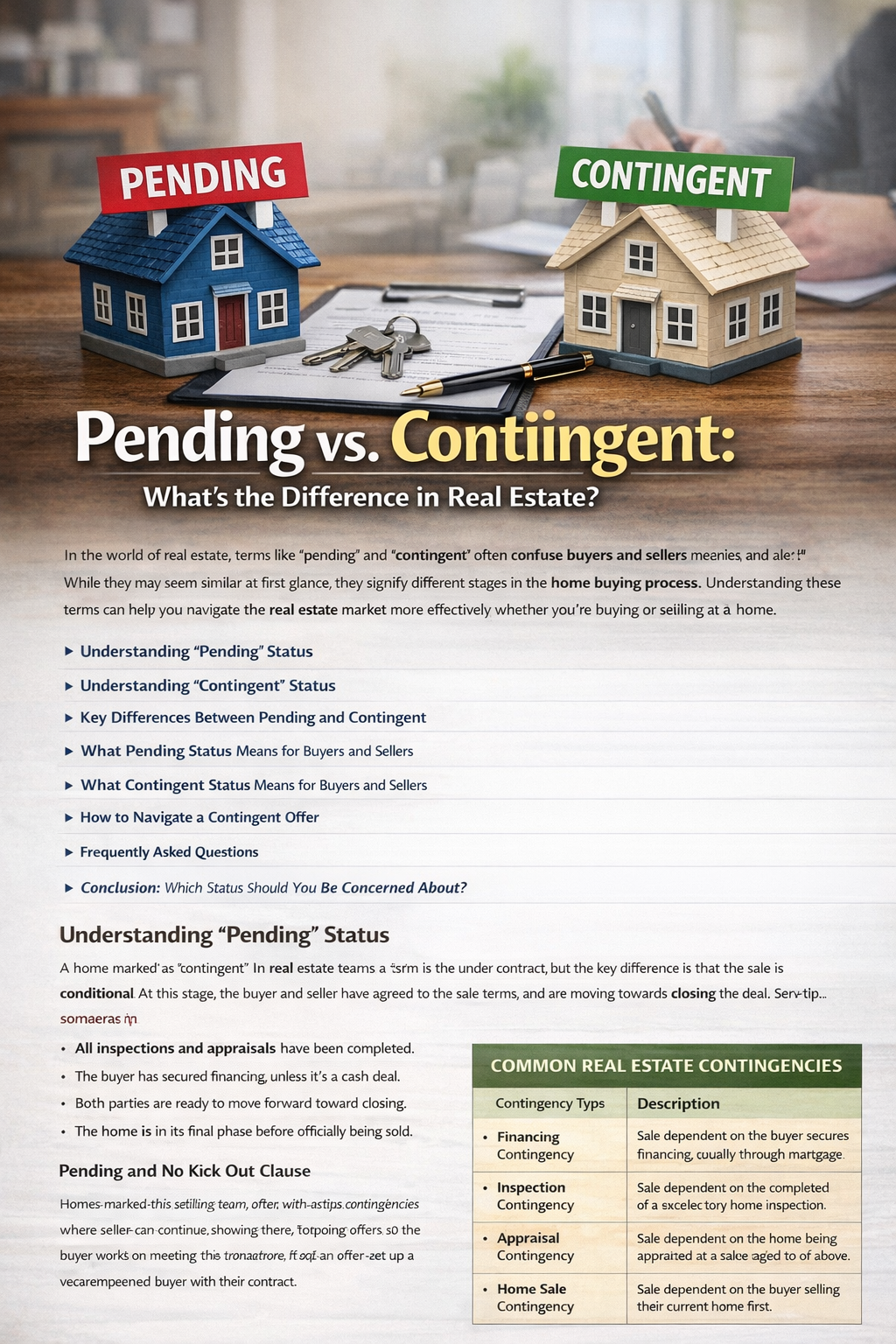
What’s the Difference in Real Estate?
If you’ve ever browsed listings on platforms like Zillow, Redfin, or Realtor.com, you’ve likely seen property statuses such as “Pending” or “Contingent.” To many buyers and sellers, these terms seem interchangeable. However, in the world of real estate, they represent very different stages of a transaction.
Understanding the distinction between pending vs contingent is crucial whether you’re buying your first home, selling property, or investing in real estate. These statuses affect negotiations, backup offers, risk levels, and the likelihood of a deal closing successfully.
This in-depth guide explains:
- What “contingent” means
- What “pending” means
- The key differences between them
- Types of contingencies
- What each status means for buyers and sellers
- How to navigate each situation strategically
- Frequently asked questions
- Expert tips for competitive markets
By the end of this article, you’ll have complete clarity on how these two statuses impact real estate transactions.
Understanding “Contingent” Status
What Does Contingent Mean?
When a home is marked contingent, it means:
- The seller has accepted an offer.
- The sale is under contract.
- Certain conditions (contingencies) must be met before the deal can close.
In other words, the sale is conditional.
If those conditions are not satisfied, the buyer can typically walk away without penalty.
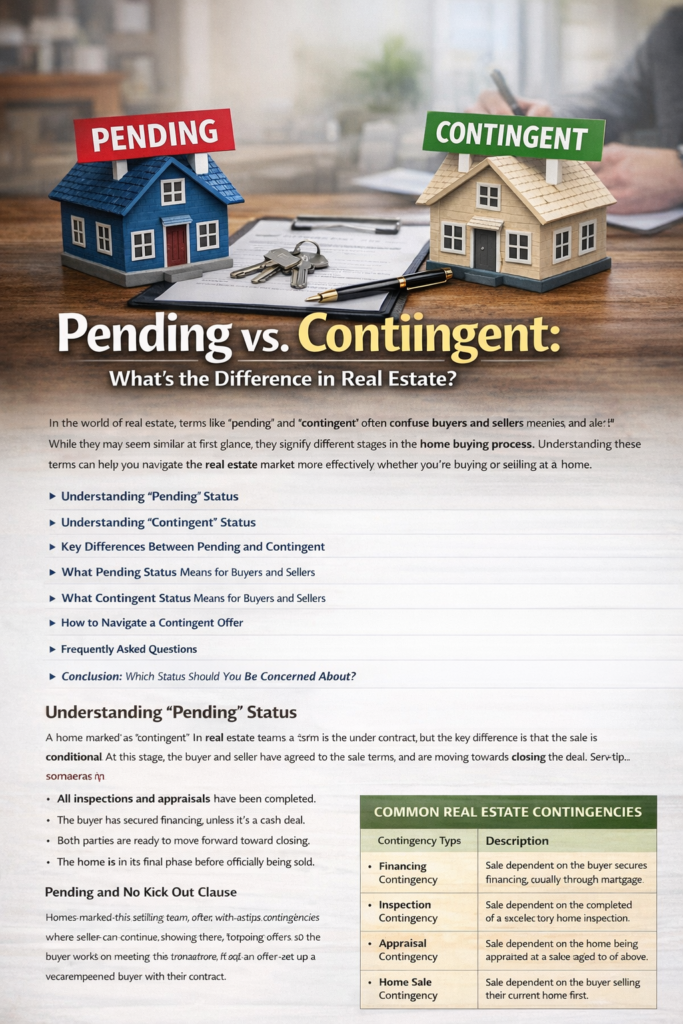
Common Real Estate Contingencies
Contingencies protect buyers and sometimes sellers. Here are the most common types:
1. Financing Contingency
The deal depends on the buyer securing mortgage approval.
If the loan is denied, the buyer can cancel the contract.
2. Inspection Contingency
The buyer can request repairs or renegotiate after a home inspection.
If major problems are discovered, the buyer may withdraw.
3. Appraisal Contingency
The property must appraise at or above the purchase price.
If the appraisal is lower, the buyer can renegotiate or walk away.
4. Home Sale Contingency
The buyer must sell their current home first.
If they cannot sell it, the contract may colapse.
Types of Contingent Statuses
Different MLS systems may label contingencies differently:
- Contingent – Continue to Show
The seller is still showing the property and may accept backup offers. - Contingent – No Show
The seller is not showing the property, but contingencies still exist. - Kick-Out Clause
Allows the seller to accept another offer if the original buyer cannot remove contingencies within a set timeframe.
Why Contingent Deals Fall Through
Contingent sales fail for several reasons:
- Financing issues
- Low appraisal
- Major inspection problems
- Buyer’s home fails to sell
- Job loss or financial instability
This means contingent properties still cary uncertainty.
Understanding “Pending” Status
What Does Pending Mean
When a property is marked pending, it typically means:
- All contingencies have been satisfied or waived.
- The transaction is moving toward closing.
- The deal is much more secure than contingent.
In simple terms:
Contingent = Conditions still need to be met.
Pending = Conditions have been met.
What Happens During Pending?
The pending stage usually includes:
- Final loan underwriting
- Title search
- Final walkthrough
- Closing preparation
- Escrow coordination
While rare, pending deals can still fall apart—but the probability is much lower.
Pending vs Under Contract
Some markets use “Under Contract” interchangeably with “Contingent.” Others use it as a broader term covering both contingent and pending.
Always confirm the specific MLS definition in your area.
Key Differences Between Pending and Contingent
| Feature | Contingent | Pending |
|---|---|---|
| Offer Accepted | Yes | Yes |
| Conditions Remaining | Yes | No (usually cleared) |
| Risk of Collapse | Moderate | Low |
| Backup Offers Allowed | Often | Rare |
| Inspections Completed | Not always | Yes |
| Financing Secured | Not always | Typically yes |
What Contingent Means for Buyers
1. You Can Submit Backup Offers
Many sellers accept backup offers on contingent homes.
If the first deal fails, you may move into primary position.
2. Higher Risk, Higher Opportunity
Contingent homes sometimes offer opportunities in competitive markets.
You may face less competition compared to active listings.
3. Be Ready to Move Quickly
If the primary contract collapses, timing is critical.
What Pending Means for Buyers
1. Lower Chances of Getting the Home
Pending homes are much closer to closing pending vs contingent.
Submitting offers is usually not productive unless backup offers are explicitly allowed pending vs contingent .
2. Limited Negotiation Room
Most terms are already finalized.
What Contingent Means for Sellers
1. Deal Is Not Guaranteed
There is still risk.
Keep communication open with your agent pending vs contingent .
2. Consider Backup Offers
Backup offers provide insurance in case the deal fails.
3. Monitor Contingency Deadlines
Ensure buyers meet financing and inspection timelines.
What Pending Means for Sellers
1. Higher Confidence
You can begin planning your move with more certainty pending vs contingent .
2. Focus on Closing Process
Work closely with your title company and lender.
How to Navigate a Contingent Offer
For Buyers:
- Get pre-approved (not just pre-qualified)
- Limit unnecessary contingencies
- Schedule inspections quickly
- Communicate with your lender
For Sellers:
- Set clear deadlines
- Use kick-out clauses if necessary
- Keep showing the property if allowed
How to Navigate a Pending Transaction
For Buyers:
- Avoid major financial changes
- Don’t open new credit lines
- Prepare funds for closing
- Complete final walkthrough carefully
For Sellers:
- Stay organized
- Provide requested documents promptly
- Prepare for closing costs
Frequently Asked Questions
Is Contingent Better Than Pending?
Not necessarily. It depends on your position.
For sellers, pending offers provide more security.
For buyers, contingent homes may offer opportunity pending vs contingent .
Can a Pending Sale Fall Through?
Yes, but rarely.
Reasons include:
- Last-minute financing denial
- Title issues
- Buyer default
Can You Make an Offer on a Contingent House?
Yes. Often as a backup offer.
Can You Make an Offer on a Pending House?
Usually no, unless the seller is acepting backup offers.
Real Estate Market Impact
In hot markets:
- Contingencies are often waived.
- Homes move quickly from active to pending.
In slower markets:
- Contingent periods last longer.
- Negotiation power shifts toward buyers.
Monitoring platforms like National Association of Realtors can provide insight into broader housing trends.
When Should You Be Concerned?
You should pay attention if:
- A property returns to market multiple times.
- Contingency periods are unusually long.
- The buyer requests multiple extensions.
These may indicate instability.
Final Thoughts: Pending vs Contingent
The difference between pending and contingent boils down to certainty.
- Contingent: The deal has conditions attached.
- Pending: The deal is nearly finalized.
For buyers, contingent listings may represent opportunity.
For sellers, pending status brings peace of mind pending vs contingent .
Understanding these distinctions allows you to negotiate smarter, move strategically, and avoid surprises in the real estate process.
READ MORE: TECHBIZZ.CO.UK
