



Introduction to Aggregate Demand
Aggregate-demand is one of the most powerful and fundamental concepts in macroeconomics. It represents the total demand for goods and services within an economy at a given overall price level and during a specific time period. When economists discuss economic growth, inflation, unemployment, or recession, they almost always refer back to aggregate-demand.
Understanding aggregate-demand is essential for students, policymakers, investors, and business leaders because it explains why economies expand, contract, overheat, or stabilize. Whether it is a developing economy like Pakistan or a global superpower like the United States, aggregate-demand plays a central role in shaping economic outcomes.
This article provides a deep and detailed exploration of aggregate-demand, including its components, formula, curve, determinants, shifts, real-world examples, relationship with aggregate supply, and its role in economic policy.
What Is Aggregate Demand?
Aggregate-demand refers to the total spending on final goods and services in an economy at a particular price level and time period.
In simple words, it measures how much people, businesses, the government, and foreign buyers want to spend.
Economists use the following formula to calculate aggregate-demand:AD=C+I+G+(X−M)
Where:
- C = Consumption
- I = Investment
- G = Government Spending
- X = Exports
- M = Imports
Each component plays a critical role in determining the overall level of economic activity.
Components of Aggregate Demand
1. Consumption (C) in Aggregate Demand
Consumption is the largest component of aggregate-demand in most economies. It refers to household spending on goods and services such as food, clothing, education, healthcare, and entertainment.
Factors affecting consumption in aggregate-demand include:
- Disposable income
- Consumer confidence
- Interest rates
- Wealth levels
- Taxes
For example, during economic uncertainty—such as the global crisis caused by the COVID-19 pandemic—consumers reduced spending, which caused aggregate-demand to fall significantly worldwide.
2. Investment (I) in Aggregate Demand
Investment includes business spending on capital goods such as machinery, factories, equipment, and technology. It also includes residential construction.
Investment in aggregate-demand depends on:
- Interest rates
- Business expectations
- Economic growth forecasts
- Technological innovation
When interest rates are low, businesses borrow more to invest, increasing aggregate-demand. Conversely, high interest rates reduce investment spending.
3. Government Spending (G) in Aggregate Demand
Government spending refers to public expenditure on infrastructure, healthcare, education, defense, and public services.
Governments often increase spending during recessions to boost aggregate-demand. This approach was strongly advocated by the famous economist John Maynard Keynes, who argued that government intervention is necessary when private sector demand is weak.
Government stimulus packages during economic downturns are classic examples of policies designed to increase aggregate-demand.
4. Net Exports (X − M) in Aggregate Demand
Net exports equal exports minus imports.
- Exports (X) add to aggregate-demand because they represent foreign spending on domestic goods.
- Imports (M) subtract from aggregate-demand because they represent domestic spending on foreign goods.
For example, if Pakistan exports textiles to the United Kingdom, it increases Pakistan’s aggregate-demand.
The Aggregate Demand Curve
The aggregate-demand curve shows the relationship between the overall price level and the quantity of goods and services demanded.
Why Is the Aggregate Demand Curve Downward Sloping?
The aggregate-demand curve slopes downward due to three main effects:
- Wealth Effect – When prices fall, purchasing power increases.
- Interest Rate Effect – Lower prices reduce interest rates, increasing investment.
- Exchange Rate Effect – Lower domestic prices increase exports.
These effects explain why lower price levels increase total demand.
Shifts in Aggregate Demand
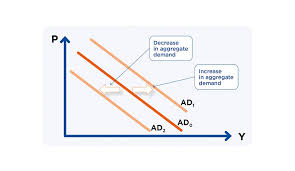
Aggregate-demand can either increase (shift right) or decrease (shift left).
Increase in Aggregate Demand
Factors causing an increase:
- Higher consumer confidence
- Lower interest rates
- Expansionary fiscal policy
- Increased exports
- Tax reductions
For instance, during periods of economic recovery in the United States, government stimulus policies significantly increased aggregate-demand.
Decrease in Aggregate Demand
Factors causing a decrease:
- Higher taxes
- Rising interest rates
- Decreased government spending
- Economic uncertainty
- Decline in exports
A fall in aggregate-demand often leads to recession.
Aggregate Demand and Aggregate Supply Relationship
Aggregate-demand does not operate alone. It interacts with aggregate supply (AS) to determine:
- Price levels
- Output
- Employment
When aggregate-demand exceeds aggregate supply, inflation occurs. When aggregate-demand is lower than aggregate supply, unemployment increases.
This interaction determines macroeconomic equilibrium.
Aggregate Demand and Inflation
Excessive aggregate-demand can cause demand-pull inflation. This happens when too much money chases too few goods.
For example, rapid economic expansion in large economies like China has sometimes resulted in inflationary pressures due to high aggregate-demand.
Aggregate Demand and Unemployment
When aggregate-demand falls, businesses reduce production and lay off workers, leading to higher unemployment.
This relationship is central to macroeconomic policy decisions worldwide.
Role of Monetary Policy in Aggregate Demand
Central banks influence aggregate-demand through monetary policy.
By adjusting interest rates and money supply, central banks can:
- Stimulate spending
- Reduce inflation
- Stabilize economic growth
Lower interest rates increase borrowing, which boosts consumption and investment, increasing aggregate-demand.
Role of Fiscal Policy in Aggregate Demand
Fiscal policy involves government taxation and spending decisions.
Expansionary fiscal policy (higher spending or lower taxes) increases aggregate-demand.
Contractionary fiscal policy reduces aggregate-demand.
Keynesian economics strongly supports fiscal intervention to stabilize aggregate-demand during economic downturns.
Real-World Example of Aggregate Demand
During the COVID-19 crisis, many governments worldwide implemented stimulus packages to prevent aggregate-demand from collapsing.
These policies included:
- Direct cash transfers
- Business loans
- Increased public spending
- Tax relief
Such measures aimed to stabilize consumption, investment, and overall economic activity.
Aggregate Demand in Developing Economies
In developing countries, aggregate-demand is often sensitive to:
- Political stability
- Currency exchange rates
- Foreign investment
- Export performance
Countries relying heavily on exports experience large shifts in aggregate-demand when global demand changes.
Importance of Aggregate Demand in Economic Growth
Sustained economic growth requires stable and increasing aggregate-demand.
When aggregate-demand grows steadily:
- Businesses expand
- Employment increases
- Income rises
- Living standards improve
However, excessive growth can cause inflation, while weak growth leads to stagnation.
Long-Run vs Short-Run Aggregate Demand
In the short run, changes in aggregate-demand primarily affect output and employment.
In the long run, economies adjust, and price levels rise, reducing the real impact of aggregate-demand increases.
Criticism of Aggregate Demand Theory
Some economists argue that focusing too much on aggregate-demand ignores structural issues like productivity, education, and supply-side reforms.
Supply-side economists emphasize aggregate supply instead.
However, most modern macroeconomic policies consider both aggregate-demand and aggregate supply.
Aggregate Demand and Business Cycles
Business cycles—periods of expansion and contraction—are closely tied to fluctuations in aggregate demand.
- Expansion = Rising aggregate-demand
- Recession = Falling aggregate-demand
Understanding aggregate demand helps predict economic trends.
Conclusion: Why Aggregate Demand Matters
Aggregate demand is the heartbeat of any economy. It determines output, employment, inflation, and growth.
From household consumption to government spending, from investment decisions to international trade, every economic action contributes to aggregate demand.
Whether analyzing policy decisions in the United States, economic reforms in China, or trade relations with the United Kingdom, aggregate demand remains central to understanding macroeconomic performance.
A strong understanding of aggregate-demand equips individuals with the knowledge to interpret economic news, analyze government policies, and make informed financial decisions.
In the grand orchestra of economics, aggregate-demand is not just a component — it is the conductor guiding the rhythm of growth, stability, and prosperity.
READ MORE: TECHBIZZ.CO.UK
